An Otaku Theology

Contemporary otaku culture constitutes, beyond visual and narrative expressions, a form of informational aesthetic religion. Its center does not reside in dogmas, but in recurring archetypes; not in commandments, but in moral affects organized by fiction. The consumption of works from the so-called “otaku culture” does not occur as simple passive entertainment, but as ritual participation in a symbolic universe that offers meaning, duty, and vitality.
All art, like any other cultural vector, is first and foremost an information system. But in the otaku context, this information is not objective, scientific, or practical—it is existential. The works reveal ways of life, stage ethical dilemmas, and offer models of conduct. The recurrence of weak protagonists who triumph through the strength of conviction, purity, or moral suffering structures the perception that personal overcoming is not the fruit of strength, but of morality. Anime is a civilizational tool.
It is extremely important that you understand this, so I make a point of repeating:
What we have here is a systematic inversion of the natural principle of strength—the idea that the most adapted, the strongest, the most aggressive wins. In its place, a theology of purity is proposed, where the one who suffers most, loves most, believes most, wins.
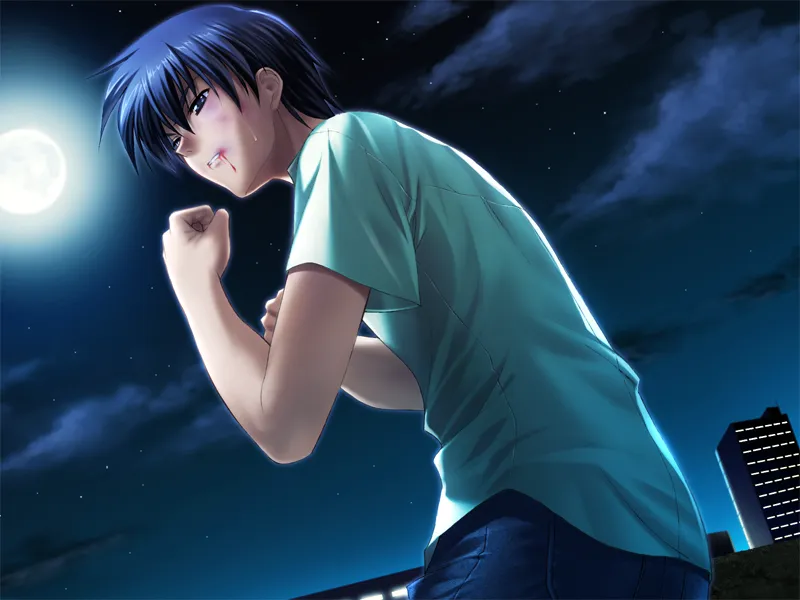
If being an otaku is being religious, the center of this religion is a divinity we could call the “True God.” This entity, though never named in the works, is symbolically omnipresent. It is a feminine, moral, interior divinity, in opposition to the exterior world of masculinity, objectivity, and brutality.
The world in which it dwells is not this one, but a reverse world, with its own logic. The otaku lives in this world; it is, therefore, a creature of the inverse. And if the surface world is governed by force, the reverse world is governed by tenderness, duty, contemplation of good.
Morality here is not an external imposition, but an ontological state. To be pure is to be strong. The aesthetic of fragility—of the magical girl, the ethical warrior, the reluctant hero, the loli vampire—is merely the visible form of an inverted hierarchy, where the last becomes first.

Within this cosmology, two ideal types are distinguished:
Type A, masculine, seeks reconciliation with the exterior world. It is the otaku who aspires to integrate, albeit in conflict, with society. Who seeks a mythology of active protagonism, honor, and moral dramas.
Type B, feminine or feminized, rejects the world and takes refuge entirely in fiction. Lives the ecstasy of moral, contemplative, melancholic escapism.
Both, however, serve the same aesthetic divinity and participate in the same quest to map God. Both seek power—not physical, but symbolic-informational. A power that allows them to act, love, or simply exist with dignity in a world that marginalizes them.
In the symbolic system that structures the otaku’s aesthetic religion, the feminine is not merely a represented gender—it is a moral principle. Idealized femininity does not correspond to the empirical woman, but to the idea of an absolute value embodied in fragility.
Therefore, so many central characters are fragile girls, sick, forgotten, or immature. They are not erotic objects in the sexual sense, but incarnations of the need for care, the value of dedication, redemption through empathy, appreciation of naive and intuitive simplicity.
The protagonist, almost always masculine, is not a conqueror, but a devotee on a mission. His function is not to dominate the feminine, but to protect it, understand it, or heal it. In this sense, the idealized woman becomes the form through which the otaku relates to the “True God.”

If the feminine represents good, then the suffering born from this vulnerability is also its necessary price and, sometimes, its own content. There is no salvation without pain. The tear, the trauma, the disease, the loneliness, the impotence—these elements are not narrative obstacles, but rites of passage.
This aesthetic of suffering is clearly Christian in structure, though not in explicit content: there is a martyrdom, there is a symbolic cross, and there is a hope of salvation.
The great thesis is that fiction, by moralizing the individual, grants them power over reality. This power is not supernatural in the physical sense, but a re-enchantment of the ego: the idea that, by incorporating the logic of the hero—one who fights with a wooden sword, but with unwavering conviction—one becomes capable of facing reality head-on, even if fragile.
The otaku who believes in this symbolic structure does not consider themselves weak: they consider themselves blessed by an invisible superior force, born from fidelity to “true morality,” to the true order of things.
Hiroki Azuma would analyze archetypal recurrence as a characteristic of postmodern consumption—a consumption without meaning and merely escapist. However, narrative formulas and archetypes are not signs of impoverishment, but of faith. Just as in a cathedral each stained glass window represents an aspect of the same divinity, each anime, however similar to the previous one, offers a new facet of the same ideal. Repetition becomes ritual; the accumulation of variations, a process of theological deepening.
The goal of otaku culture is not pure innovation, but the renewal of aesthetic faith. Reject any accusation of cliché. To see again, under new light, that which one already loves—this is the true act of devotion.

Similar Posts ↑
- Art (1 shared tags)
- Database Animals (2 shared tags)
- Teleportation Mechanics (1 shared tags)
- Avant Otaku (1 shared tags)
- Kaijimaxxing (1 shared tags)
- Anime or Something Like It (1 shared tags)
- CCRU (1 shared tags)
- Nick Land (1 shared tags)
- The Holy City (1 shared tags)